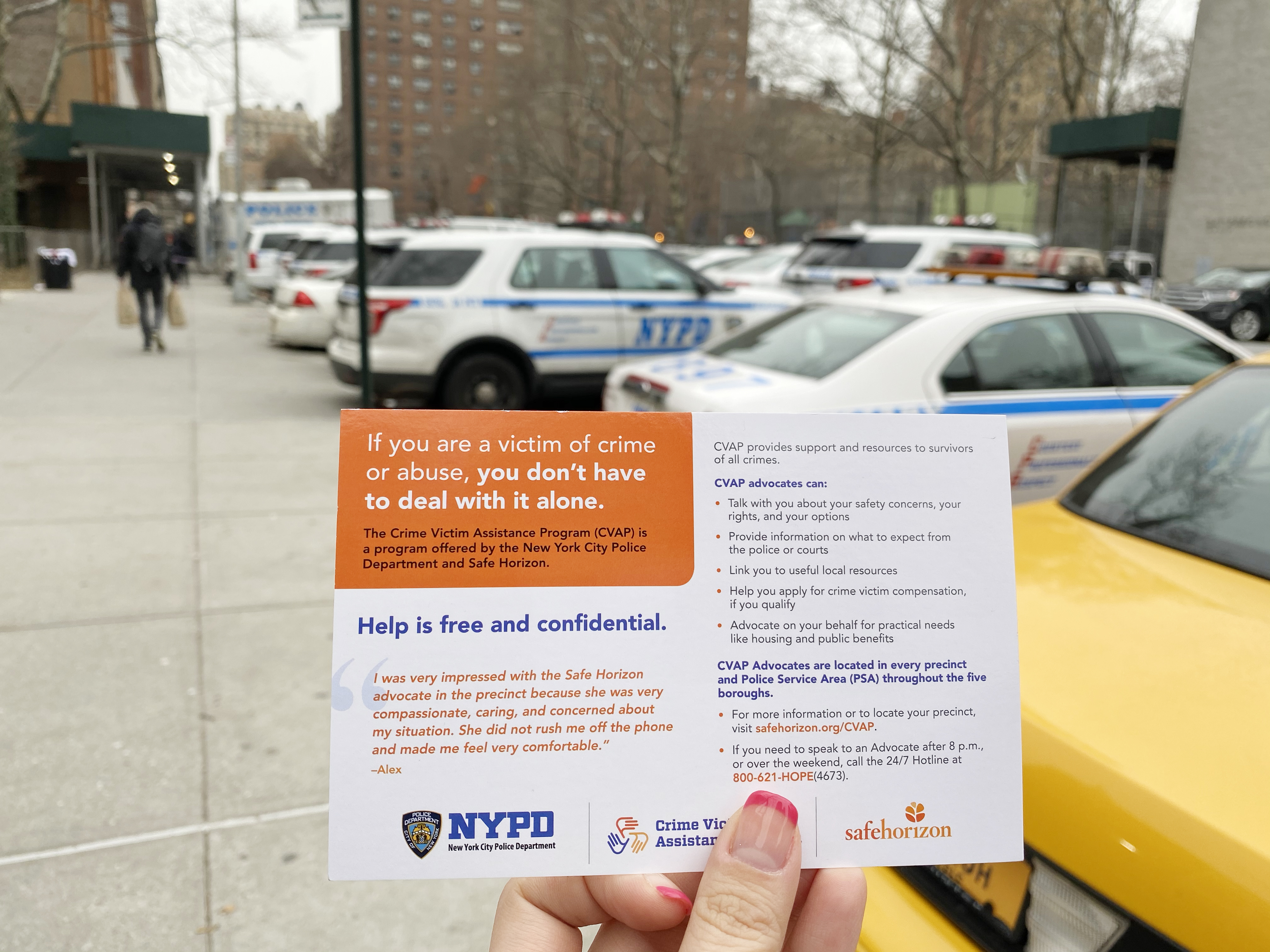
NYPD's 24th precint provides Safe Horizon Program for domestic violence victims.(Min Ji Koo/NYC News Service)
NYPD's 24th precint provides Safe Horizon Program for domestic violence victims.(Min Ji Koo/NYC News Service)
Brooklyn has a decreased number of domestic violence victims in 2018 compared to its 2013, and experts say that we might see a result of whole communities' years of work.
16 Days of Activism Against Gender-Based Violence(GBV), New York City's campaign for rooting out domestic violence, observed its last 16th day on Dec. 10, 2019. In September of 2018, Mayor Bill de Blasio initiated the Mayor’s Office to Combat Domestic Violence and the mayor's office to End Domestic and Gender-Based Violence (ENDGBV) to accelerate the New York City’s strategic response to domestic violence. Now the city is on the last moment of its 2019, and New York State's data indicates that Brooklyn shows the best result of the city's effort.
"Now, New York City has a bunch of resources to educate communities about family violence and help domestic violence victims. I think that makes a slow but firm effect on domestic violence in the city," said Elian Diaz, a domestic violence associate working with Safe Horizon. She added that usually, metropolitan cities deal with fast-growing numbers of domestic violence cases, but New York City seems like it oppresses the growing of the crime.
Dots in this map mark the location of the domestic violence program working with ENDGBV, and how 2018's number of domestic violence victims is different from 2013's. The darker the color, the more increased the number of victims. The map was made out of The Division of Criminal Justice Services' reports in 2013 and 2018 and NYC open data.
New York States' data show that the number of domestic violence victims is averagely 7% increased around the city. Still, only Brooklyn recorded 4% decrease in the number of domestic violence victims in 2018 compared to 2013. Dr. Christopher Herrmann, a specialist in crime statistics at John Jay College, said, "It's difficult to say what triggered the decrease from the data, but the 4% decrease is meaningful when the average is the 7% increase."
In addition, Brooklyn has the largest number of family centers in five boroughs in New York City. However, considering the increased number of DV victims in Manhattan, it is difficult to say that the decrease of DV victims in Brooklyn is directly related to the number of family centers.
Prof. Julie Goldscheid, an expert on domestic violence at CUNY law school, also couldn't give a firm explanation of how the number of victims in Brooklyn goes down. However, she made it clear that not only appropriate laws but also people's supportive attitude to endorse equivalent partnerships are critical to stopping domestic violence through her work."I haven't tracked the data in NYC, but it's a great sign."
Brooklyn community district 10, which contains Bay Ridge and Dyker Heights, shows the lowest number of family-related domestic incidents in 2018, according to ENDGBV's report. Officer Porcello said that eradicating domestic violence can be succeed only if the government, law enforcement, local precincts, and community members are all active to prevent domestic violence at NYPD's 68th precint, which is geographically responsible to Bay Ridge area. "I think this number came out of the whole community's cooperation."